


A girlfriend experience, or GFE, usually means paid interaction designed to feel personal and relationship-like rather than simply providing access to content. On creator/fan platforms, that can involve conversation, thoughtful check-ins, and an agreed style of attention. But there is an important distinction here: FIWFans has been associated with a Thai advertising platform, not a verified equivalent of a subscription-based creator service, and Thai authorities have documented its closure following a trafficking investigation. This article explains the nonexplicit, online meaning of GFE while separating general guidance from claims about FIWFans that should not be assumed. Get the Best information about Fiwfans.
What does the girlfriend experience mean on creator/fan platforms?
On creator/fan platforms, the girlfriend experience generally describes a paid, relationship-style interaction between an adult creator and an adult fan. The emphasis is on personalized attention and a sense of ongoing familiarity, often through text, voice, or video communication. It is a commercial arrangement, not an automatic promise of a real romantic partnership.
For the purposes of this article, the focus is strictly on nonexplicit online companionship. Think of conversations about everyday interests, friendly encouragement, or remembering something a person mentioned earlier. Those examples illustrate a communication style; they are not a claim that FIWFans provides particular features or packages.
The most useful way to understand the term is to separate three things:
- The tone: Warm, attentive, and possibly affectionate, within mutually accepted limits.
- The activity: Whatever communication or content the actual offer clearly describes.
- The relationship: A paid creator/fan interaction, rather than a personal commitment outside that arrangement.
Keeping these separate makes expectations easier to discuss. Someone might enjoy a friendly conversation without wanting romantic language. Another person might welcome affectionate language but prefer not to discuss work, family, or other personal subjects. Neither preference should need a defense.
Personalized attention is not unlimited access
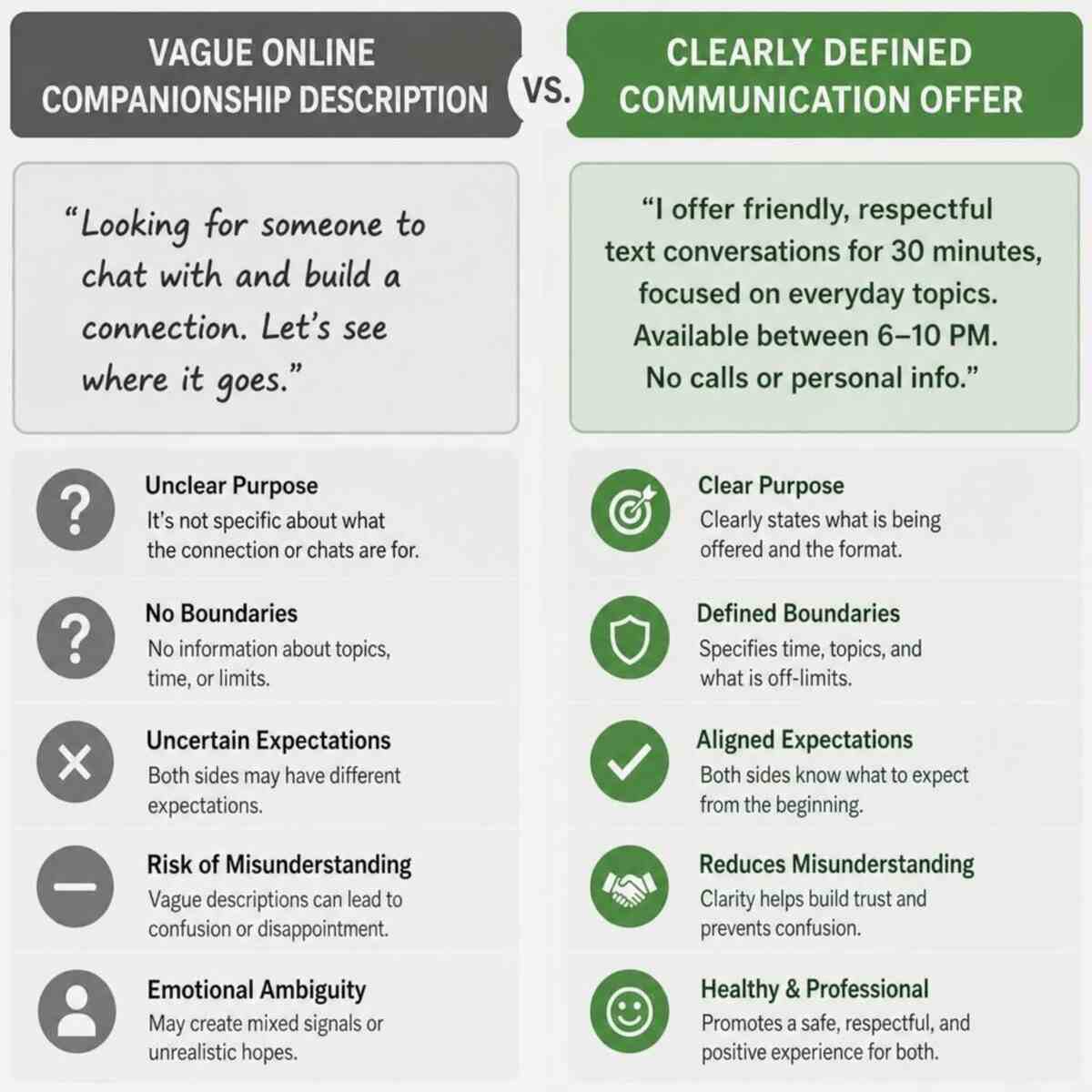
A useful standard for any lawful online companionship offer is specificity. “Personal attention” should be explained in terms a reader can understand, not left as an emotional promise. For example, an offer could identify its communication format, availability, and topic limits without claiming that the creator will always be reachable.
Consider the difference between these hypothetical descriptions:
Vague: “I’ll always be here for you.”
Clearer: “Conversation is available during the stated hours. Replies are not continuous, and personal contact details are not included.”
The second description may sound less romantic, but it gives both people something useful: a shared understanding. It also leaves room for sleep, other commitments, and the ordinary fact that no one can maintain constant attention.
The label does not define the agreement
Treat “GFE” as a starting point for understanding an offer, not as a complete description. Write down what the wording actually promises. Then separate that from anything you merely hope it means.
A simple exercise helps: make two columns labeled stated and assumed. Put “voice messages included” in the first column only if the offer says so. Put “the creator will become emotionally attached” in the second, because that is not something you should treat as a deliverable.
How does this apply to FIWFans specifically?
The phrase “Girlfriend experience on Fiwfans” needs careful interpretation because the available evidence does not establish FIWFans as a conventional creator subscription platform with verified GFE messaging tools. A Thai government progress report describes the original Fiwfans as a prostitution advertising website and records its eventual closure following investigations involving exploitation of minors. That history makes it misleading to present the name as an ordinary, verified fan-content service.
Reporting published on January 26, 2025, described a police announcement made on January 24, 2025, about the platform’s dismantling and arrests connected to the investigation. This is historical context, not evidence that every similarly named website has the same operator or features.
A currently accessible FAQ using a similar name, Fiwfan, describes profiles, review-related features, video clips, and communication through external messaging services. It also makes its own claims about verification and continuity between domains. Those are the site’s statements, not independent proof of ownership, safety, or a reliable verification process.
Relationship-style presentation is different from platform functionality
A profile can use warm language or describe companionship without the website itself delivering a structured online GFE service. Likewise, a short introduction video does not establish that ongoing video conversations are included. Read each type of information for what it actually says.
For understanding FIWFans-related material, keep these distinctions in view:
| Information presented | What it may tell you | What you should not assume |
|---|---|---|
| A personal profile | How an account presents itself | Independent confirmation of every claim |
| A sample video | What a particular recording shows | Guaranteed live interaction or current identity |
| A review | What a reviewer alleges | Consistent future conduct or safety |
| An external messaging reference | That communication may leave the website | Continued website oversight or dispute support |
| A verification symbol | That the site assigns a status | A comprehensive safety guarantee |
This table is a reading framework, not an endorsement of any account or service. Its purpose is to prevent a small piece of information from becoming a much larger assumption.
Avoid importing features from other platforms
Do not describe FIWFans as having subscriptions, paid inboxes, recurring billing, escrow, encryption, or refund protection unless reliable documentation establishes those exact features for the exact service being discussed. This article does not verify those capabilities.
If you searched for “girlfriend experience fiwfans,” the key clarification is straightforward: a search phrase does not establish how a website works. Understand the underlying service model before applying familiar creator-platform expectations to it. Where ownership or safeguards remain unclear, uncertainty is a reason to stop, not an invitation to fill in the blanks.
GFE compared with other online interactions
It helps to compare expectations rather than marketing labels. Before deciding what any interaction means, identify its main purpose: viewing content, having a limited conversation, participating in relationship-style entertainment, or seeking professional support. These categories help you read an offer, even when a website uses different terminology.
| Interaction | Main focus to clarify | Important limit to recognize |
|---|---|---|
| Content access | Which posts, recordings, or materials are available | Access does not automatically include personal replies |
| A one-time conversation | The format and scope of a particular exchange | One conversation does not establish ongoing availability |
| Relationship-style companionship | The agreed style and continuity of communication | Warmth does not establish a private romantic commitment |
| Dating | Each person’s intentions and expectations | Interest must not be presumed from paid interaction |
| Professional support | Qualifications, scope, and appropriate care | Companionship should not be treated as clinical care |
Use this comparison as a question-writing tool. If you cannot tell which category an offer belongs to, avoid deciding based on a friendly photograph or an affectionate greeting. Look for a plain description of what the interaction actually involves.
For example, someone seeking occasional conversation may not want an arrangement built around frequent romantic language. Someone wanting access to creative work may have no interest in personal messages at all. Being clear about that difference is more useful than deciding which label sounds most appealing.
The same principle applies to creators. Describe the experience in terms of actions and limits, rather than suggesting it can meet every emotional need. A specific description gives readers a fairer basis for deciding whether the interaction fits their expectations.
Reading profiles and offers without overinterpreting them
For lawful, nonexplicit online companionship, use a profile review to assess clarity and accountability—not to hunt for the most convincing romantic presentation. Start with the written description. Attractive presentation should never replace clear terms.
A practical review should cover these areas:
- Scope: Does the description identify conversation, recordings, live sessions, or another format?
- Availability: Are communication hours and time zones understandable?
- Limits: Are excluded topics, personal contact, and recording rules addressed?
- Identity presentation: Is it clear whether the account represents one person, a team, or an automated persona?
- Privacy: Is there an accessible explanation of how information is handled?
- Accountability: Is there an identifiable operator and a usable reporting process?
- Exit terms: Can you understand how to stop participation or cancel any recurring arrangement?
You do not need to collect invasive personal information to assess these points. Ask for clarity about the service, not access to someone’s private life. If basic information is unavailable, leave the uncertainty unresolved rather than trying to investigate the person behind an account.
Read availability literally
Treat “daily contact” as incomplete unless the description explains what it means. It could refer to a scheduled message, a response window, or something else entirely. For evaluation purposes, do not translate that phrase into continuous conversation.
Time zones deserve special attention for US readers evaluating overseas services. Ask for an explicit time zone whenever hours matter. A schedule that says “evenings” is not useful until you know whose evening it describes.
Also distinguish a response target from a guarantee. If the wording does not explain weekends, absences, or interruptions, note those gaps rather than assuming your preferred interpretation.
Evaluate consistency without demanding private proof
The FBI recommends researching profile photographs and details when checking for romance scams. A reverse image search may reveal conflicting names or stories, but its results should be interpreted carefully. The goal is to notice inconsistencies, not to locate someone’s home, family, or private accounts.
Avoid treating a request for identity documents as a normal step in a conversation. If a platform requires formal verification, examine its documented process and data practices separately. Do not exchange sensitive documents with an individual simply because a conversation feels reassuring.
Communication norms and boundaries
A useful communication agreement should make ordinary interaction easier, not turn every message into a negotiation. Start with availability, acceptable topics, and how to raise a concern. Keep the wording direct enough that both people can refer back to it later.
Here is a suggested boundary checklist for nonexplicit online companionship:
- Use only communication channels both people have accepted.
- Respect the stated schedule instead of demanding immediate replies.
- Ask before introducing sensitive personal topics.
- Do not demand legal names, addresses, or private social accounts.
- Do not interpret silence as permission to escalate contact.
- Honor a refusal without repeatedly rewording the request.
- Accept that either person may end a conversation.
These are proposed ground rules, not a description of verified FIWFans policies. Their value is that they turn an abstract instruction such as “be respectful” into observable behavior.
Make requests specific and easy to decline
Compare “Why aren’t you giving me enough attention?” with “Can you clarify the usual reply window?” The second question identifies an information gap without making a personal accusation. It also creates room for a useful answer.
Similarly, “Are you comfortable discussing work stress?” is clearer than immediately sending a long account of a difficult situation. Permission to chat does not need to be treated as permission for every possible subject. Start small and accept the answer.
Creators can use the same approach when stating limits: “I don’t discuss that topic, but we can change the subject.” A short boundary is enough. There is no need to turn private reasons into material for debate.
Address mismatches without pressure
If an interaction differs from its written description, identify the specific mismatch. Refer to the stated format, schedule, or other relevant term. Avoid turning a service concern into a demand for affection or personal reassurance.
For example:
“The description mentioned scheduled text conversations, but I haven’t received information about the schedule. Please clarify the arrangement and the available resolution process.”
This wording keeps the issue concrete. It does not accuse someone of having false feelings, and it does not make emotional closeness the remedy. If clarification does not resolve the mismatch, consider ending participation through the applicable process.
Do not continue contacting someone across multiple accounts after they have asked you to stop. Use a legitimate support or dispute channel for unresolved administrative issues. Keep personal contact separate from complaint handling.
What do consent and privacy require in online GFE?
For this article’s nonexplicit context, a sound standard is clear, voluntary agreement about the interaction, its limits, and how personal material may be used. Participation in one conversation should not be treated as blanket permission for new topics, recordings, public sharing, or contact elsewhere. This applies the broader consent principles of clear communication, mutual respect, and ongoing agreement described by RAINN.
Payment should never be used to pressure someone past a stated boundary. If an agreed service cannot continue, handle the practical issue through the relevant terms or resolution process. Do not frame continued personal participation as something owed regardless of consent.
A useful way to keep permissions separate is to ask what action is being proposed:
| Proposed action | Permission to clarify |
|---|---|
| Starting a sensitive subject | Whether the person wants to discuss it |
| Saving a personal recording | Whether saving is permitted and for what purpose |
| Publishing a testimonial | Whether the wording and identifying details are approved |
| Sharing a conversation with a third party | Whether sharing is appropriate, necessary, and permitted |
| Moving to another account or channel | Whether both people accept that change |
Do not bundle these into a single “yes.” Someone may welcome a private exchange while refusing public use of their words. Keep each permission limited to the actual action under discussion.
Also distinguish consent from reluctant compliance. As a practical rule, stop negotiating when someone seems uncomfortable or says no. Repeated requests can turn a simple choice into pressure.
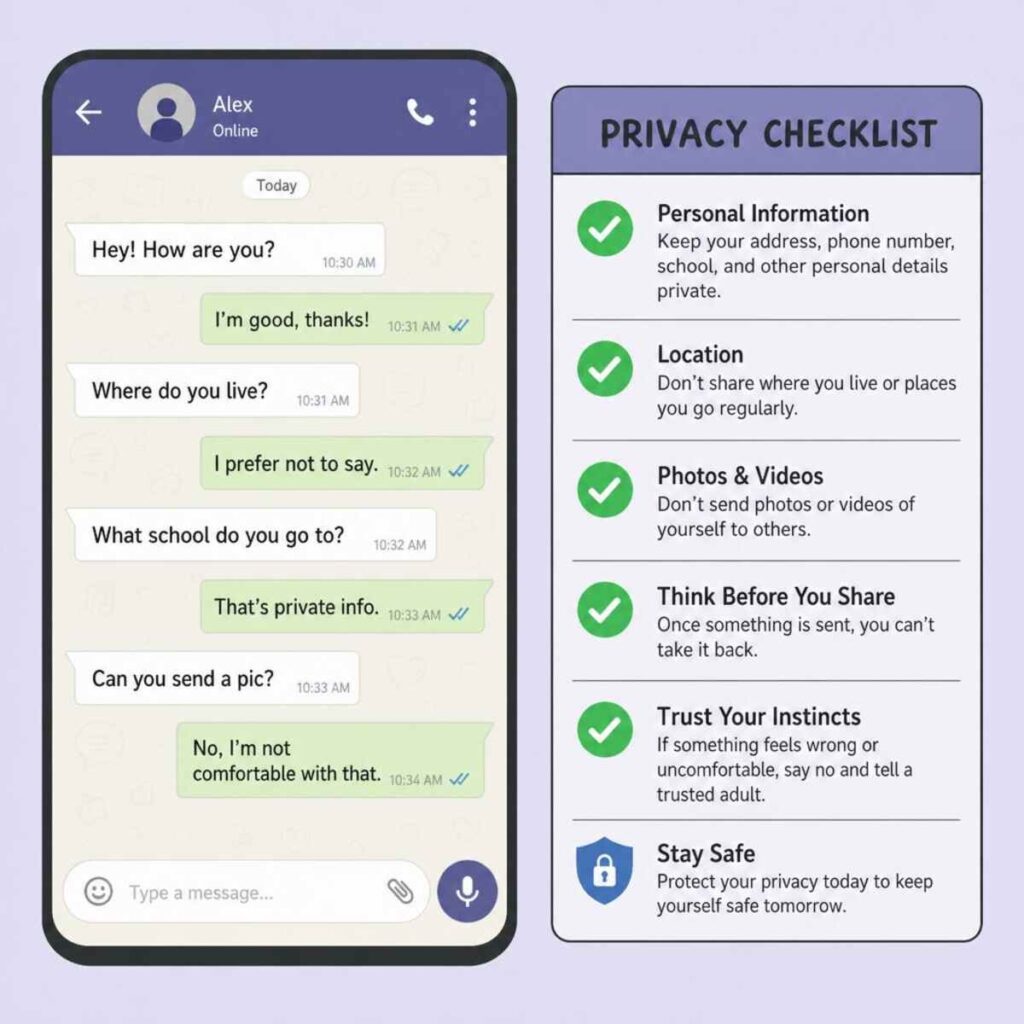
For creators, make room for fans to decline, too. Avoid suggesting that a refusal to share a photograph, reveal personal information, or continue a conversation proves a lack of trust. Privacy preferences should not become a loyalty test.
Privacy practices for fans and creators
Start with data minimization: before sharing a detail, ask whether it is necessary for the interaction. For casual online conversation, consider keeping addresses, employers, financial records, identity documents, and family information out of the exchange. Make that your default rather than deciding in the moment under pressure.
For account security, enable multifactor authentication wherever it is available, including on the email account used for recovery. CISA recommends MFA across accounts and apps that support it. This adds a login security step; it is not a promise that the account or its conversations are completely private.
Separate three privacy questions when reviewing any platform:
- Account visibility: What can other users see on your profile?
- Operator access: What does the service say it collects, stores, or shares?
- Recipient behavior: What rules address copying, recording, or redistributing an exchange?
Look for answers in the exact service’s documentation. Do not import an answer from a different platform with a similar name. If a policy is unavailable or unclear, do not describe the service as confidential.
Reduce links to your personal identity
PEN America’s digital-safety guidance recommends reviewing your online footprint and limiting exposed personal information to reduce doxxing risks. Consider whether usernames, profile images, old posts, and public records create connections you did not intend. Review those connections without trying to uncover someone else’s private identity.
A practical privacy review can be simple: inspect your public profile while logged out, review what your messaging account displays, and check what a newly added contact can see. Decide what belongs there before starting a personal conversation. Repeat the review after changing accounts or settings.
For creators, apply similar care to published material. Before uploading an image, inspect it for information you did not intend to share. Before publishing a testimonial, obtain permission for both the wording and any identifying details.
Prepare for doxxing without retaliating
Doxxing involves exposing sensitive personal information to enable harassment, intimidation, or related harm. If it happens, report the material to the hosting platform and assess whether it creates an immediate safety concern. PEN America advises considering law enforcement when exposed information may reach someone intent on causing harm.
Do not respond by publishing the other person’s information. Keep the response focused on removal, documentation, account protection, and appropriate help. A payment disagreement or disappointing interaction never justifies exposing someone’s identity.
Recognizing scams and manipulative requests
Separate a clearly described commercial interaction from a person using romantic claims to solicit emergency money. The FTC warns that romance scammers build trust and then seek money, often directing people toward payment methods that are difficult to reverse. Requests for gift-card codes, wire transfers, or cryptocurrency deserve particular caution in that context.
Use a pause rule whenever a request combines urgency, secrecy, and money. Don’t decide when someone insists that immediate action proves you care. Step away from the conversation and review the request independently.
Watch for these patterns:
- A claimed personal emergency becomes a demand for financial help.
- Someone pressures you to keep the request secret from trusted people.
- An unexpected “verification” or “unlock” payment appears without clear documentation.
- A supposed support agent requests account credentials or recovery codes.
- Romantic language is used to discourage reasonable questions.
- An account asks you to receive or move money on someone else’s behalf.
The FBI specifically warns that requests to use your bank account can involve other theft or fraud schemes. It also cautions against people who try to isolate you from friends and family or quickly push communication away from the original service.
An external messaging request alone does not settle whether an account is fraudulent. Instead, assess what protections, documentation, and accountability would remain after the move. Do not mistake familiarity with a messaging app for verification of the person using it.
If you suspect romance fraud, the FTC recommends stopping communication, speaking with someone you trust, contacting the payment company or bank promptly if money was sent, and reporting the incident. Use the FTC’s reporting service and notify the platform where the contact began.
Do not blame yourself for needing a second opinion. Make it a habit to get one before responding to an unusual financial request, rather than waiting until you feel certain something is wrong.
Payments, cancellations, and chargebacks
For any lawful digital service, understand the transaction before authorizing it. Identify the merchant, the described service, whether payment recurs, and how cancellation works. This is general consumer guidance, not confirmation that FIWFans offers a particular payment system or supports protected transactions.
Keep a compact transaction record containing the offer description, confirmation, receipt, and relevant support exchanges. Avoid collecting unrelated personal conversations just because they are available. The aim is to document what was agreed and what happened, not build a file on another person.
Distinguish a billing problem from disappointment
When raising a concern, describe it accurately. A charge you did not authorize is different from an authorized purchase that was not delivered as described. Both are different from receiving the stated service but finding that the experience did not meet a personal hope.
For example, “The scheduled conversation did not occur” identifies a concrete issue. “The creator did not develop feelings for me” describes an expectation that should not have been treated as a service outcome. Keep those categories separate when asking for help.
For US credit-card billing errors, the CFPB advises notifying the card company promptly and sending a written billing-error notice within 60 calendar days after the charge appeared on the statement to protect applicable rights. Different issues can involve different processes, so follow the issuer’s instructions rather than assuming every dispute works the same way.
Use disputes honestly and keep records secure
A chargeback should not be used to punish someone for enforcing boundaries. Describe the authorization and delivery facts truthfully. Do not threaten a dispute to obtain extra attention, private information, or continued contact.
Creators should likewise avoid promising that a “no refunds” statement resolves every possible dispute. For complaints about an otherwise authorized purchase, the CFPB recommends explaining the issue to the seller and contacting the credit-card company about available dispute options when necessary.
When responding to a legitimate claim, provide only the relevant documentation through the proper channel. Do not post private conversations publicly as leverage. A financial disagreement should remain a financial disagreement, not become an exposure threat.
Ethical responsibilities in relationship-style services
A useful ethical standard is simple: neither person should have to misunderstand the arrangement for it to continue. Warm communication and commercial clarity can exist together. Do not present transparency as something that ruins the experience.
For creators, that means describing what is actually offered without implying personal commitments that are not intended. For fans, it means respecting the creator as a person rather than treating payment as ownership. Both sides should be able to refuse, leave, and protect private information without retaliation.
Be honest about who is communicating
If personal interaction is central to an offer, make authorship clear. A sensible transparency standard is to disclose meaningful staff involvement, automation, or an AI persona before a user relies on an impression of direct personal contact. This is a recommended ethical practice, not a claim about FIWFans operations.
Avoid vague wording that leads a reader to believe every message comes directly from one person when that is not the intended arrangement. Equally, fans should not demand access to internal business details unrelated to their expectations or privacy. Focus the disclosure on what matters to the interaction.
A useful test is to ask: would a reasonable person make a different decision if they understood who was replying? If the answer might be yes, clarify it rather than relying on ambiguity.
Do not use emotional pressure to increase spending
Avoid messages that frame payment as proof of affection or make continued warmth depend on an unexpected financial demand. State optional purchases as optional. Keep changes in scope separate from claims about loyalty, worth, or personal commitment.
Fans should apply the same principle in reverse. Do not use spending history to demand exclusivity, private access, or control over a creator’s life. Gifts and payments should not become a running argument that boundaries no longer apply.
Finally, do not proceed when adulthood, willingness, or safety is uncertain. The documented FIWFans investigation makes exploitation concerns particularly relevant to this topic. Treat credible signs of coercion or underage involvement as reasons to stop and report, not as details to overlook.
Managing expectations and ending participation
Before beginning any relationship-style online interaction, decide what role you want it to have in your life. Write down a time limit, a spending limit, and a few personal boundaries. Keep that note separate from the conversation so you can review it without pressure.
Useful self-check questions include:
- Am I choosing this interaction freely, or responding to guilt?
- Am I expecting something the description never promised?
- Can I tolerate normal gaps in communication?
- Would I still feel comfortable explaining my spending decision to someone I trust?
- Can I stop without trying to punish the other person?
These are reflection prompts, not diagnostic tests. You don’t need to label your feelings to decide an arrangement no longer suits you. A simple mismatch is enough reason to leave.
If you stop, separate the practical steps. Cancel any applicable recurring arrangement through its documented process, retain necessary transaction records, and review account permissions. Do not assume that ending a conversation automatically completes those administrative tasks.
Where contact becomes threatening or harassing, preserve relevant messages, account information, dates, and links before they disappear. PEN America recommends documenting online abuse to support reports and other responses. Store the evidence securely rather than circulating it publicly.
Frequently asked questions about related situations
These questions cover a few practical details that can remain even after the main boundaries are clear. Use the answers as general reading guidance, not as statements about undocumented FIWFans features.
Can a creator keep a public-facing name instead of sharing a legal name?
As a privacy practice, respect a public-facing identity rather than demanding private documents in conversation. Evaluate the platform’s accountability and any formal verification process separately. A chosen name does not resolve every trust question, but refusing invasive disclosure should not itself be treated as proof of wrongdoing.
Should someone publish screenshots to warn others about a bad experience?
Start with private documentation and the appropriate reporting process. Public screenshots can expose information unrelated to the complaint, so consider what is necessary before sharing anything. PEN America’s documentation guidance emphasizes saving relevant evidence, including context, for reports and potential escalation.
What if an account claims that payment will prove it is genuine?
Do not treat a payment demand as identity verification. Ask whether there is an independently understandable process, and decline pressure to act immediately. The FBI identifies verification schemes as a romance-scam concern; a familiar platform name or affectionate conversation is not a substitute for careful assessment.
Does deleting an account settle a payment dispute?
Do not assume it does. Treat account closure, cancellation, and a billing complaint as separate tasks, and follow the relevant documented procedures for each. Keep the records needed to explain the payment issue before removing access to them.
The practical takeaway
Understanding GFE services starts with understanding the actual arrangement: who is communicating, what is promised, what is excluded, and how either person can stop. Keep warm language separate from assumptions about romance, privacy, or unlimited access.
For FIWFans specifically, avoid treating similarly named sites or unsupported feature claims as verified facts. Its documented history calls for careful context, not promotional assumptions. The soundest approach is to prioritize lawful, nonexplicit interaction, clear consent, limited data sharing, and the freedom to walk away whenever the situation is unclear.
