


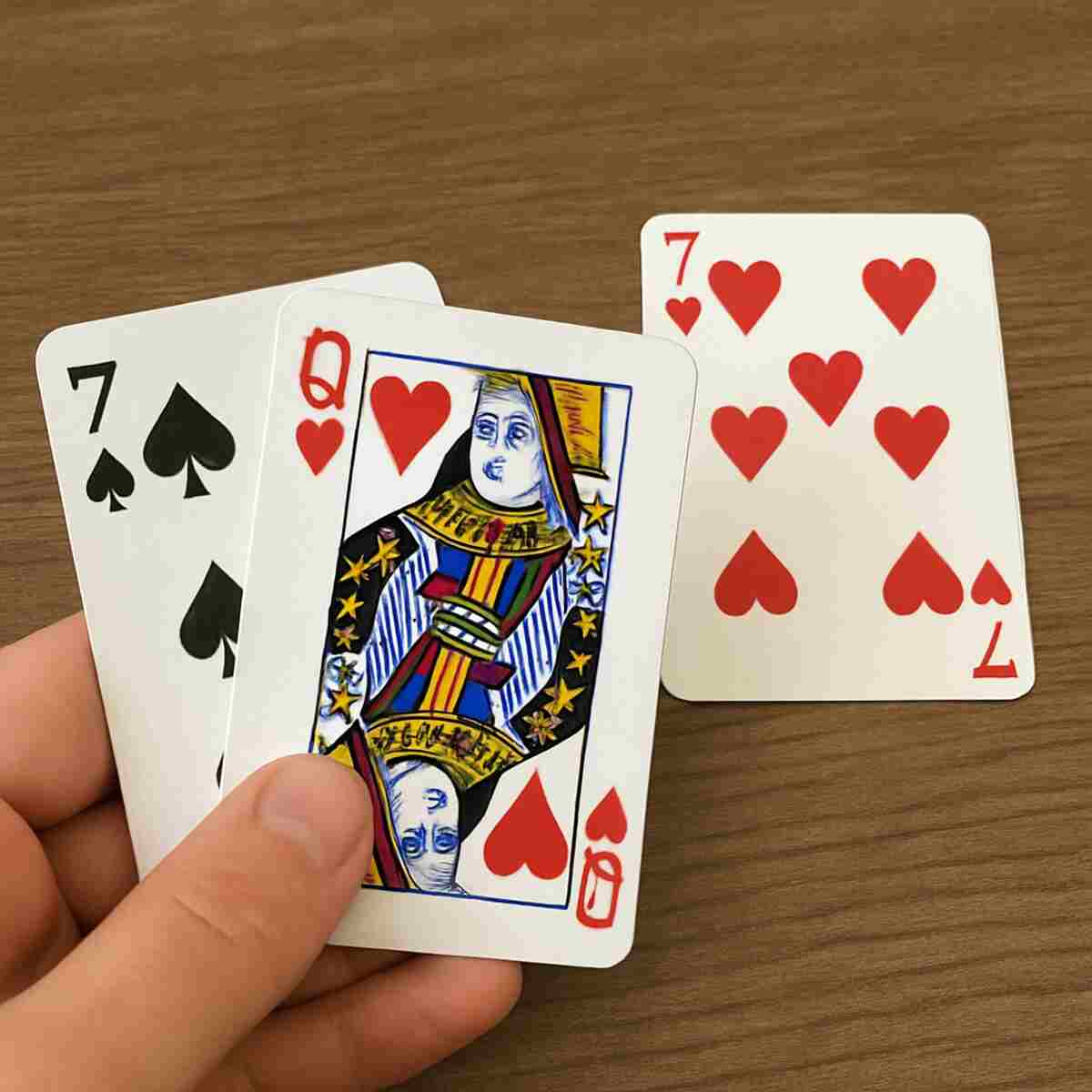
Got seven people around the table, a deck of cards, and that familiar feeling of uncertainty? Finding fun card games for 7 people can feel like a puzzle, especially when so many classics seem designed for smaller, even-numbered groups. But here’s the secret: that “awkward” number is actually perfect for some of the most engaging and memorable games you can play. Check out slot online to know more
To help you find the right fit for your group’s current mood, we’ve broken down our top picks into a few categories. Whether you want something fast-paced or a bit more thoughtful, a great choice is waiting for you.
- For a Quick & Chaotic Night: Games where laughter and speed are the main goals.
- For a Classic & Strategic Vibe: Timeless games that reward a bit of clever thinking.
- For a Lively & Deceptive Party: Fun options involving bluffing and social interaction.
Each game below comes with simple, step-by-step rules you can learn in five minutes flat—no prior experience needed. So, stop worrying about finding card games for an odd number of people and get ready to deal everyone in on the fun.
Quick & Chaotic: How to Play Crazy Eights with a Big Group
If your group is looking for something fast, a little chaotic, and incredibly easy to learn, Crazy Eights is the perfect choice. The goal is simple: be the first person to get rid of all the cards in your hand. For seven players, you’ll need to shuffle two standard 52-card decks together. Deal seven cards to each person, place the rest of the deck face-down to form a draw pile, and flip the top card over to start the discard pile.
On your turn, you must play a card from your hand that matches the top card of the discard pile in either number or suit. For example, if the top card is a 10 of Spades, you could play any other 10 (like the 10 of Hearts) or any other Spade (like the 4 of Spades). If you can’t play a matching card, you must draw one card from the deck. If that new card is playable, you can put it down immediately; otherwise, your turn ends.
This is where the “crazy” part comes in. Any 8 is a wild card, meaning you can play an 8 on top of any other card, no matter the suit or number. After playing an 8, you get to announce which suit the next player must match. This powerful move can completely change the flow of the game and is your best tool for getting out of a tough spot.
The first person to play their last card wins the round! You can declare them the winner, or if you want to play a longer game, you can keep score. At the end of each round, players add up the value of the cards left in their hands (Aces are 1 point, face cards are 10, and 8s are a whopping 50). The first person to reach a set score, like 200, loses. For groups that prefer a bit more strategy over pure chaos, you might enjoy a classic trick-taking game instead.
Classic Tricks: Mastering the Rules of 7-Player Hearts
If a game with a little more thinking sounds good, it’s time to learn Hearts. This is a classic trick-taking game, but with a clever twist: your goal is to score as few points as possible by avoiding certain cards. It’s one of the best card games for an odd number of people because it creates fun, strategic tension.
To play 7-player Hearts, you’ll need one standard 52-card deck. Since the deck doesn’t divide evenly, simply remove three low-value cards before you begin—the 2s of Clubs, Diamonds, and Spades are perfect choices. This leaves 49 cards, so after a shuffle, you can deal exactly seven cards to each player.
The game is played in rounds called “tricks.” The player to the dealer’s left starts by playing any card. In clockwise order, every other player must play a card of the same suit if they have one; this is called following suit. For instance, if a Diamond is led, you must play a Diamond if you can. The person who plays the highest card of the original suit “wins” the trick, takes all seven cards, and starts the next trick.
So why would you want to avoid winning tricks? Because some cards carry penalty points! At the end of a hand, each player counts the penalty cards they’ve collected. The game ends when one player hits 100 points, and the person with the lowest score wins. The cards to watch out for are:
- Any Heart card = 1 point
- The Queen of Spades = 13 points
Beyond the Basics: How to Play Poker at a 7-Person Table
Looking for a game with a bit more bluffing and betting? Poker is a fantastic choice, and a 7-person table is perfect for the most popular version, Texas Hold’em. The game’s appeal lies in combining the cards you’re dealt with shrewd bets to outwit your opponents. To begin, don’t worry about everyone putting money in at once. Instead, the two players to the left of the dealer post small, forced bets called blinds to create an initial pot. Then, the dealer gives every player two private cards, face down.
The real action revolves around the community cards—cards dealt face-up in the middle of the table that everyone can use. After an initial round of betting based on your two private cards, the dealer reveals three community cards (called the flop). This is followed by another round of betting. Then comes a fourth card (the turn) and a fifth and final card (the river), each with a betting round. Your goal is to create the best possible five-card hand using any combination of your two private cards and the five community cards on the table.
But what makes a hand “the best”? Poker hands are ranked in a specific order. While several rankings exist, you only need to know the strongest ones to get started. Here are the top hands, from nearly unbeatable to still very powerful:
- Royal Flush: The 10, Jack, Queen, King, and Ace, all of the same suit.
- Straight Flush: Any five cards in sequence, all of the same suit (e.g., 5-6-7-8-9 of Hearts).
- Four of a Kind: Four cards of the same rank (e.g., four Jacks).
- Full House: A combination of three of a kind and a pair (e.g., three 8s and two Kings).
- Flush: Any five cards of the same suit, not in sequence.
Don’t have a set of poker chips? No problem. Simply give everyone a starting score on a piece of paper (say, 100 points) and subtract their bets from their total as they play. The winner of a pot adds the total amount bet to their own score. This simple method keeps the game moving without any special equipment. While poker brings out the strategist, some nights call for pure social chaos and deception.
Up next: Lively & Deceptive: How to Play Werewolf with Only a Standard Deck
Lively & Deceptive: How to Play Werewolf with Only a Standard Deck
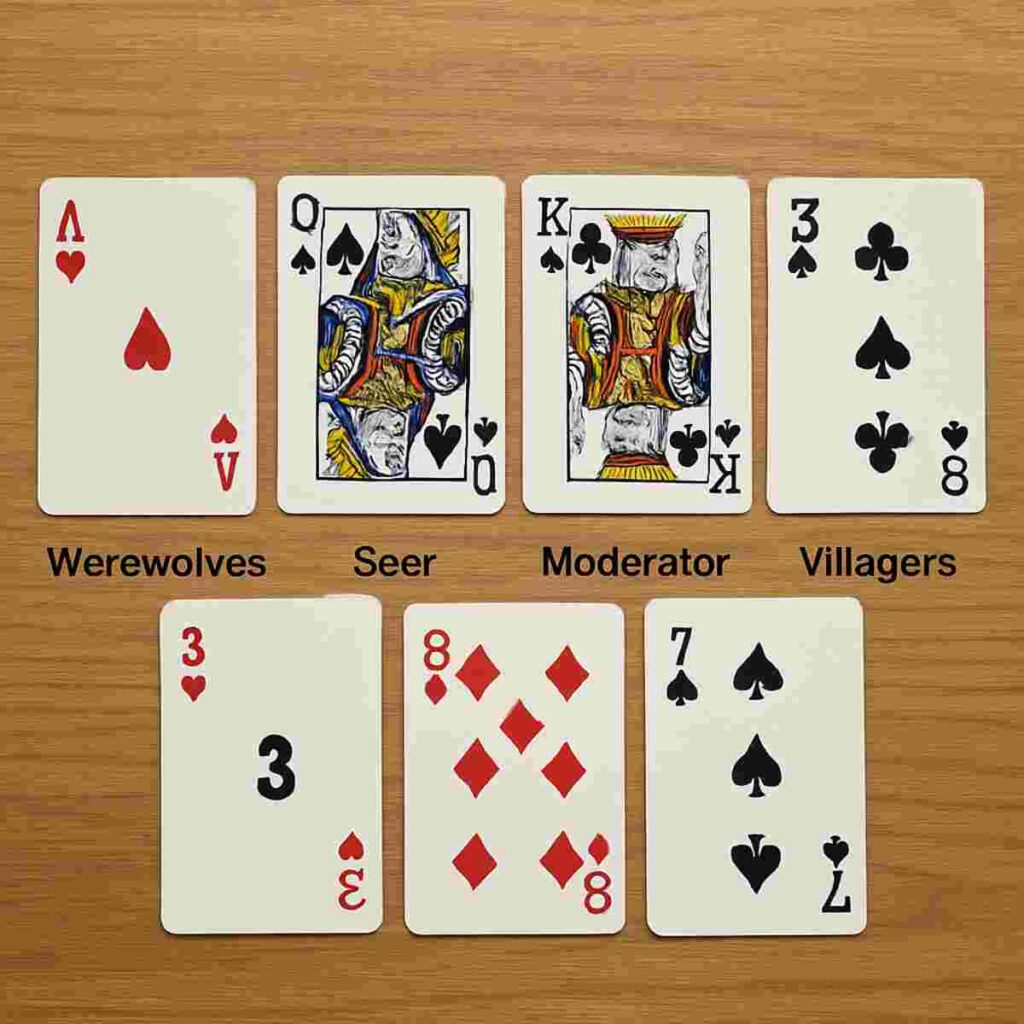
If your group is looking for one of the best party card games for seven players, where trust is fragile and accusations fly, then Werewolf is your answer. You don’t need a special box set—just seven specific cards from a standard deck. First, assign everyone a secret role by dealing one card face down to each person. For a 7-player game, use two red Aces (the Werewolves), a Queen (the Seer), a King (the Moderator), and any three numbered black cards (the Villagers). The King reveals themself and will guide the game, but they are also a regular Villager trying to survive. Everyone else keeps their role a secret.
The game unfolds in two phases, starting with “Night.” The Moderator tells everyone to close their eyes. They then ask the Werewolves (the two red Aces) to silently open their eyes and agree on one player to eliminate. After the Werewolves close their eyes, the Moderator asks the Seer (the Queen) to wake up and silently point at one player. The Moderator will then give a thumbs-up if that player is a Werewolf, or a thumbs-down if they are not. This gives the Seer a crucial piece of information to use later.
Once the sun “rises,” the Moderator tells everyone to open their eyes and announces who was “eliminated” by the Werewolves during the night. That person reveals their role and is out of the game, unable to speak for the remainder. The “Day” phase is now pure discussion and deception. Players debate who might be a Werewolf, with the Seer trying to guide the town without revealing their own identity and becoming a target. After a few minutes of chaos, the Moderator calls for a vote, and the player with the most votes is also eliminated.
Victory depends entirely on which team achieves its goal first. The Villagers (including the Seer and Moderator) win if they successfully vote out both Werewolves. The Werewolves, on the other hand, win if they survive long enough to equal the number of Villagers remaining, giving them a majority. For example, if it comes down to one Werewolf and one Villager, the Werewolves win. It’s a game of suspense and social maneuvering that requires no complex scoring. But what do you do when the rules aren’t so flexible?
What If Your Favorite Game Is for 4 Players? How to Adapt the Rules for 7
It’s a common roadblock: you want to play a classic like Rummy or Spades, but the rules are designed for a neat group of four. The first and most important principle for how to adapt 4-player card games for 7 is simple: just add a second deck. For many games, shuffling two standard 52-card decks together provides more than enough cards to deal everyone in without running out. This easy fix is the foundation for turning many small-group games into a version that works for a crowd.
Of course, more cards don’t solve the problem of partnership games. When you have an odd number, the best solution is to play “cutthroat” style—every player for themselves. This is how you can handle seven-player Spades partnership rules, for example. Instead of bidding and working with a teammate, each person plays individually to make their own bid. This transforms the game from a team sport into a thrilling free-for-all where you have six opponents instead of just two.
Finally, with more players comes a much longer game. A standard 500-point game of Rummy could take all night with seven people taking turns. To keep the energy up and the pace brisk, simply adjust the finish line. If a game normally ends when someone reaches 100 points, try playing to 50 or 75 instead. This small change ensures you can actually finish a game in a reasonable amount of time, making it one of the most useful tricks for playing card games for a big group.
Stop Searching and Start Playing: Your Game Night Awaits
You no longer need to see that seventh person as a game-night complication. Where you once saw a tricky number, you can now see an opportunity. You are now equipped to be the one who gets the fun started, armed with the right game for any group mood.
To get things moving, match a game to your group’s energy. For a fast and family-friendly card game for a group, suggest a chaotic round of Crazy Eights. If your friends are ready for some bluffing and laughter, deal out a game of Werewolf. Choosing from the many fun card games for 7 people is your first winning move.
Remember, the ultimate goal isn’t to follow every rule perfectly—it’s to connect and share a great time. The best game is simply the one you’re about to play. So pick one, deal the cards, and let the night begin.
