


Incheon outcall massage brings a massage appointment to your home, hotel, or another agreed location rather than requiring a visit to a treatment room. The techniques worth understanding include Swedish massage, deep tissue work, focused pressure, sports massage, and gentler options with stretching or scent. This guide explains what those approaches involve, how to describe your preferences, and what to check before booking. There is no single technique that suits everyone, so the aim is to choose a comfortable, professionally delivered session—not simply the strongest treatment on the menu. Often the Amazing fact about 서울출장마사지.
What is an Incheon outcall massage session?
An Incheon outcall massage session is a visiting appointment in which a practitioner travels to an agreed address to provide massage. “Outcall” describes where the service happens, not the technique, pressure, or training involved. One local provider, for example, advertises house-call appointments using Swedish, deep tissue, and aromatherapy approaches; that does not establish what every provider offers. Always confirm the actual service rather than relying on the booking label.
Start by separating three decisions: the result you want, the kind of touch you prefer, and the practical setup. You might want quiet relaxation, attention to familiar shoulder tension, or a clothed appointment without oil. Those are different requests, even if the listings place them under the same broad category.
Try writing your priorities in one short sentence before you contact anyone:
- For relaxation: “I want a calm session with light pressure and very little conversation.”
- For a particular area: “Please give my shoulders extra attention, but keep the pressure comfortable.”
- For a clothed session: “I would prefer to stay dressed and avoid oil. Which approach do you offer?”
- For a first appointment: “I am new to massage, so please explain the setup and check the pressure early.”
Use that sentence to guide the conversation. Ask the provider to explain which of their techniques fits your request and what adjustments they can make. If the answer is vague, ask for a description of what they will actually do.
Treat the information below as a way to understand service descriptions, not as instructions for treating an injury. Massage should not replace assessment of an unexplained health problem or delay appropriate medical care.
Swedish massage and its basic strokes
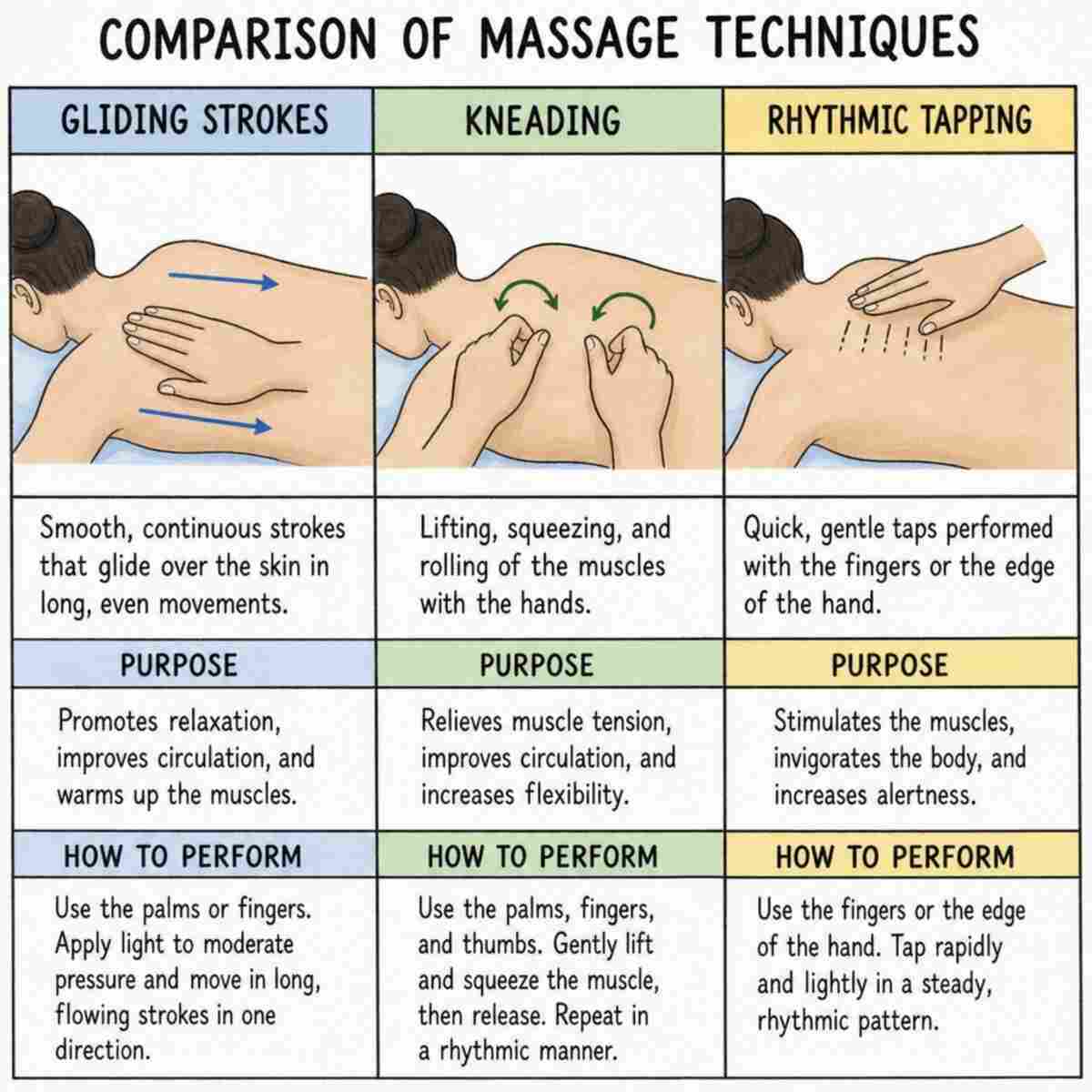
Swedish massage combines several basic movements rather than repeating one kind of rubbing throughout the appointment. Its familiar techniques include gliding, kneading, friction, vibration, and rhythmic tapping. Knowing those names helps you describe which sensations you enjoy and which you would rather skip.
For a first booking, ask what the provider means by “Swedish.” Do they mainly offer slow, flowing work, or do they include more focused movements? Request a description in everyday language rather than choosing from a list of unfamiliar terms.
Gliding strokes
Effleurage is the technical name for long, gliding strokes. The practitioner moves their hands across the skin in a slow, rhythmic way, rather than staying on one small point. Petrissage, by contrast, involves lifting and kneading muscle tissue.
If you prefer continuous movement, ask for more gliding work and fewer pauses on tender spots. You can also request slower transitions between areas. Be specific about the experience you want: “Please keep the movements broad and gentle” gives clearer direction than “Make it relaxing.”
Picture a session where you want your back and arms included without spending most of the appointment on a single shoulder. Explain that balance before the practitioner starts. Ask them to tell you if your requested coverage leaves little time for detailed work.
Kneading movements
Kneading involves lifting, rolling, or squeezing soft tissue rather than sliding continuously over it. It is one of the foundational massage movements, and its feel is different from a broad stroke across the skin.
When discussing this technique, describe both pressure and pace. “Gentle kneading, slowly” is a useful request. If you enjoy the movement on your shoulders but not your arms, say that too; you do not need one instruction for your entire body.
Avoid judging the session by how much pressure you can tolerate. Ask for adjustments based on comfort instead. A simple “That movement is fine, but lighter please” lets you keep the part you like without accepting an intensity you dislike.
Friction, tapping, and vibration
Friction uses smaller, more concentrated movements, while tapotement refers to rhythmic percussion or tapping. Vibration adds a shaking or vibrating movement. These are separate techniques, so a Swedish appointment need not feel the same from beginning to end.
Ask whether the practitioner plans to include these movements. If you want a quiet, unhurried experience, request that they leave out brisk tapping. If you dislike repetitive movement over one spot, ask them to explain any focused work before beginning it.
You do not need to memorize the French terminology. “Long strokes,” “gentle kneading,” and “no tapping” communicate useful preferences. Before booking, check that the practitioner understands those instructions in the language you will use during the appointment.
Deep tissue massage and controlled pressure
Deep tissue massage is associated with work on deeper muscular problems, rather than simply offering a more forceful version of a relaxation session. The label alone does not tell you how a particular practitioner will structure the appointment. Ask which areas they plan to address and how they will adapt the work to your comfort.
Do not book it just because “deep” sounds more effective. Instead, explain your reason for considering it. You might say, “I have a familiar feeling of tightness around my shoulders, and I would like focused attention there.” That gives the practitioner something to discuss without asking them to diagnose the cause.
Pressure should remain adjustable
Severe pain is not an expected requirement of massage. Mayo Clinic advises asking for lighter pressure when anything feels too strong and notes that some soreness can occur afterward, depending on the approach. You should not have to endure a painful session to receive a worthwhile one.
Agree on plain feedback before the work begins. You could use “comfortable,” “lighter,” and “stop” instead of trying to assign a number to every sensation. Whatever system you choose, make sure both of you understand it.
Ask for a gradual start rather than requesting maximum pressure immediately. If you are unsure, say so: “I do not know my preference yet; please start gently.” Leave room to change your mind as the appointment continues.
Keep the plan focused
For a targeted booking, choose a main priority and a secondary one. For example, request extra attention to your upper back while keeping the rest of the appointment gentle. Ask the practitioner whether that plan fits the time you are considering.
Avoid handing over a long list of areas and expecting detailed treatment of all of them. Instead, discuss the trade-off between broader coverage and concentrated attention. A clear agreement is more useful than an ambitious plan that neither person has time to complete.
Finally, do not interpret bruising or intense discomfort as proof that deeper work succeeded. Massage has a low overall risk of harm, but rare serious adverse effects have been reported, including after vigorous techniques and among people at increased risk of injury. Share relevant health information before choosing a forceful approach.
Trigger point work and myofascial techniques
Focused techniques may appear alongside Swedish or deep tissue massage rather than as entirely separate appointments. Cleveland Clinic lists trigger point work, myofascial release, and stretching among techniques that practitioners may incorporate according to their training and a person’s needs. Ask what a provider includes instead of assuming every menu uses the same definitions.
The practical distinction is between broad coverage and attention to a more limited area. Before agreeing to focused work, ask the practitioner to explain its purpose in your proposed session. You should understand where they intend to work and what feedback they want from you.
Trigger point work
Trigger point work directs attention to particular tender areas. Discomfort associated with a trigger point may be felt locally or elsewhere, but tenderness is not something you need to identify or diagnose yourself. Describe what you notice and leave clinical assessment to an appropriately qualified professional.
For example, say, “This area beside my shoulder feels tender when touched,” rather than insisting that a particular muscle needs to be released. Ask whether the practitioner recommends gentle local work, a broader approach, or referral for assessment. You can decline any suggestion that does not feel appropriate.
During the appointment, give useful feedback without trying to prove anything. “That spot is more sensitive than the surrounding area” is enough. If a sensation concerns you, ask the practitioner to stop and discuss it rather than continuing while you work out how to describe it.
Myofascial release
Myofascial release uses gentle, sustained pressure directed at myofascial tissue. Fascia is connective tissue that covers and supports muscles and other structures. This approach can therefore feel different from a massage built around repeated gliding movements.
If you see the term in an Incheon service listing, ask how the provider performs it. Will they use direct skin contact, sustained holds, or a combination with other techniques? Ask how much of the appointment they propose spending on it.
Keep expectations practical. Rather than requesting a permanent structural change, identify a modest goal you can discuss afterward: comfort while sitting, for example, or how an ordinary movement feels. Do not treat a claim about “releasing fascia” as a guarantee of a particular result.
For either focused approach, ask the practitioner to explain any change of plan. You may agree to attention around one shoulder without wanting extended work on your neck or another sensitive area. Make those boundaries explicit before the session moves on.
Sports massage and assisted stretching
Sports massage is intended to support people around physical activity, but that purpose should not be confused with a promise of better athletic performance. A systematic review found no evidence of direct improvements in several performance measures, although massage was associated with small improvements in flexibility and delayed-onset muscle soreness. Treat it as a possible comfort or recovery option, not a shortcut to fitness.
When asking about this service, describe your activity and the timing. Explain whether you are planning an easy day, have just exercised, or have a demanding event ahead. Ask the practitioner to explain the proposed approach rather than requesting the most intensive option available.
Give context without making a diagnosis. “My legs feel tired after a long walk” is different from “I injured my calf yesterday.” Do not book routine sports massage as a substitute for having a new injury assessed.
Stretching requires a separate conversation
Stretching may be included in a massage appointment, but it should not be a surprise. Some massage services incorporate passive-resistive stretching and other movement-based techniques. Ask whether stretching is part of the advertised session and whether you can choose massage without it.
Before agreeing, discuss the following:
- Position: Ask whether you will be on a table, mat, or another surface.
- Clothing: Confirm what to wear so you can move comfortably while remaining appropriately covered.
- Control: Agree that the practitioner will pause or stop immediately when asked.
- Limitations: Explain known restrictions, recent injuries, and any instructions from your healthcare professional.
- Preference: Say whether you want gentle movement only or would rather skip stretching entirely.
Do not use the appointment to test how far a joint can move. Ask for an explanation before unfamiliar positions and decline anything you do not want. Your request can remain simple: “Please keep every movement easy and tell me before changing position.”
Shiatsu and clothed pressure-based massage
Shiatsu is a Japanese bodywork approach that can combine pressing, kneading, tapping, and stretching. It is commonly performed through loose clothing, often on a floor mat. That makes it a different experience from an oil-based table massage, although you should confirm the actual setup before booking.
Consider asking about it if remaining clothed is important to you. Do not assume that any service described as “dry massage” is shiatsu, however. Request the technique name, a description of the movements, and details of the practitioner’s relevant training.
For a visiting appointment, ask who supplies the mat and how much clear floor space is needed. If getting down to the floor would be difficult, discuss that before choosing the service. Do not wait until arrival to discover that the proposed arrangement will not work for you.
Set preferences for the areas included. For example, you might welcome pressure over your back and arms but prefer no abdominal work or stretching. State that clearly, even if the provider describes those elements as part of their usual routine.
Keep traditional explanations separate from medical claims. Shiatsu is sometimes described using ideas about energy pathways, but there is no scientific evidence that it can cure or prevent disease. You can choose the experience for personal comfort without accepting claims that go beyond the evidence.
Before confirming, ask what you should wear and whether any products will be used. If your reason for choosing a clothed session is avoiding oils or fragrances, say so directly. That is more reliable than assuming the service name answers every practical question.
Aromatherapy and hot stone options
Aromatherapy and heated stones add another element to a massage appointment. When comparing them, separate the underlying massage from the optional addition. First decide what kind of touch you want, then consider whether fragrance or warmth belongs in your session.
Aromatherapy massage
Aromatherapy massage combines massage with essential oils. The scent is an added component, not a separate level of pressure or a guarantee of stronger benefits. Ask which massage techniques form the base of the appointment.
Request the product names before booking, especially if you have experienced reactions to scented products. Ask whether an unscented alternative is available and whether you can see the ingredients. Avoid agreeing to an unfamiliar blend simply because it is described as natural.
Essential oils can cause skin irritation or contact dermatitis, and some citrus oils can increase sensitivity to sunlight when applied to skin. These are practical reasons to discuss the exact product rather than treating all oils as interchangeable. Do not assume that a pleasant smell means a product is suitable for you.
For a hotel or shared home, consider whether you want fragrance in the room at all. Ask the practitioner not to use a diffuser or scented spray without checking first. Your preference might be massage with a plain product and no additional scent, which is a straightforward request.
Hot stone massage
Hot stone massage adds heated stones to the appointment. Ask how the practitioner controls temperature, how the stones will be used, and whether you can switch to a session without heat. If the stones feel uncomfortable, tell the practitioner immediately rather than waiting to see whether you adjust.
Discuss health conditions before choosing this option. Professional guidance identifies several circumstances requiring particular consideration, including neuropathy, diabetes, skin conditions, recent surgery, and pregnancy. A heated treatment should not be selected without an appropriate health discussion.
For an outcall booking, also ask about equipment and setup. Confirm whether the practitioner needs access to electricity or water and where they plan to place their equipment. Keep these arrangements separate from your treatment preferences so neither gets overlooked.
Do not feel obliged to add heat because it sounds like an upgrade. If you are mainly interested in gentle kneading, request that directly. Choose an addition because you want it and it is appropriate—not because the menu presents the plain option as incomplete.
Which technique should you choose?
Choose a technique by matching your preferences, health considerations, and desired session structure—not by assuming that deeper, hotter, or more complicated means better. Use the table below as a starting point for questions, then ask the practitioner whether their training and service fit your request. Treat every recommendation as something to discuss rather than a prescription.
| Your preference | Option to discuss | Question to ask |
|---|---|---|
| Broad, flowing touch | Swedish massage | “Can you keep the strokes slow and the pressure light?” |
| Extra attention to a familiar tight area | Focused or deep tissue work | “How will you keep the work within my comfort level?” |
| A session around physical activity | Sports massage | “What approach fits my activity and current condition?” |
| Remaining dressed without oil | Shiatsu or another explicitly clothed service | “What technique and setup do you actually provide?” |
| Fragrance as part of the experience | Aromatherapy massage | “Which products will you use, and is unscented available?” |
| Warmth during the appointment | Hot stone massage | “Is heat appropriate for me, and how do you control it?” |
These options reflect different massage methods and additions, not a ranking of effectiveness. The technique names describe broad categories; the practitioner still needs to explain the proposed session.
Choose between full-body and focused work
Before selecting the appointment length, ask how the provider divides the time. Find out whether consultation, changing, setup, and packing are included in the advertised duration. Do not infer hands-on time from the headline alone.
Then choose your priorities. If you want a broad session, identify any areas you would like omitted. If one area matters most, ask for a focused plan and accept that other areas may receive less attention.
For example, you could request a gentle appointment with extra time on your shoulders and no stretching. That is a clearer brief than asking for Swedish, deep tissue, sports massage, and myofascial work all at once. Let the practitioner explain which methods they propose using to meet it.
Avoid selecting a technique just to match a popular search term. When comparing outcall massage in Incheon, use the listing to begin a conversation, not to end one. The important question is whether you understand and agree with what will happen.
Booking and preparing the space
The visiting format makes practical questions part of the booking process. Ask for written confirmation of the location, service, total charge, arrival arrangements, and cancellation terms. Keep that confirmation somewhere you can easily access without searching through several conversations.
Confirm the provider and service
Ask who will attend, what relevant training they have, and how their credentials can be checked. Also ask whether their service is appropriate for any needs you have disclosed. NIH guidance recommends asking about a massage practitioner’s training, experience, and credentials before beginning treatment.
Use this checklist before agreeing to an appointment:
- Identity: Confirm the provider’s business name and the name of the person attending.
- Service: Get a plain description of the techniques, products, clothing arrangements, and areas included.
- Cost: Request the full amount, including any travel, parking, equipment, or other charges.
- Timing: Confirm the arrival window and how the appointment duration is calculated.
- Policies: Read cancellation, refund, delay, and payment terms before paying.
- Communication: Check that you can explain pressure preferences and ask the practitioner to stop.
- Boundaries: Agree on privacy, covering, consent, and any areas that must be excluded.
Do not take a polished listing as a substitute for clear answers. If someone avoids basic questions about identity, techniques, or charges, pause the booking. Choose a provider only when you have enough information to make an informed decision.
Check hotel or building access
If you are staying in a hotel, ask the property whether visiting practitioners are permitted and what check-in arrangements apply. Do this before paying a deposit. Confirm any restrictions yourself rather than relying only on the provider’s assurance.
Give clear arrival instructions after you are satisfied with the booking. Include the correct building entrance, reception procedure, and any access steps the practitioner needs to know. Avoid sharing unnecessary personal details beyond what is needed to arrange the visit safely.
If language may be a barrier, prepare a short written list of preferences. Include your main goal, areas to avoid, product sensitivities, and the words you will use for lighter pressure or stopping. Ask the provider to confirm they understand before arrival.
Prepare a workable treatment area
Ask how much space the practitioner needs and which equipment they bring. Clear the agreed area rather than trying to guess where a table or mat should go. Keep walkways and exits accessible, and discuss any stairs or access limitations in advance.
For privacy, decide where you will change and how interruptions will be handled. Put pets in another comfortable space and silence avoidable notifications. Ask anyone sharing the accommodation not to enter during the appointment without checking.
When should you postpone massage or seek advice?
Postpone the booking or seek advice when your health makes the proposed massage uncertain, particularly with a suspected blood clot, recent injury or surgery, significant bleeding risk, or an unexplained new symptom. Massage is not a substitute for medical assessment. Mayo Clinic recommends discussing relevant conditions and health history with your healthcare team and the massage practitioner before scheduling.
Do not assume the practitioner can judge safety from a booking message alone. Explain relevant conditions and ask whether they need guidance from your clinician. If the answer is to wait, choose another date rather than pushing to keep the appointment.
Disclose medicines that may increase bleeding risk, reduced sensation, fever or contagious illness, and recent trauma or surgery. Professional precautions also identify open wounds, burns, fractures, and certain other local conditions as areas requiring avoidance or particular care. The correct adjustment depends on the situation, not simply on choosing a lighter package.
If you are pregnant, have cancer, or are managing another significant health condition, discuss suitability and modifications with your healthcare team. Ask the practitioner about training relevant to your circumstances rather than relying on a general claim of experience. Some people need an adapted approach or should avoid particular practices.
You do not need to disclose sensitive information in a public review or open booking thread. Ask for a private way to share relevant health details. At the same time, do not withhold information that the practitioner needs to decide whether the session is appropriate.
Keep your explanation factual: what happened, when it happened, what symptoms remain, and what your clinician has advised. Avoid asking the practitioner to work around an unresolved problem without discussing it. If you are unsure whether something matters, raise it before the appointment rather than after treatment begins.
Communication during the session and practical aftercare
Before the practitioner starts, review the plan in ordinary language. Confirm the areas included, anything excluded, the preferred pressure, and whether products, heat, or stretching will be used. Ask them to check with you before adding something you have not discussed.
Give clear feedback early
Use short, direct instructions instead of waiting for discomfort to become difficult to ignore. “Lighter on this side” is more helpful than silently hoping the next movement will change. You can also say that the pressure is comfortable while asking for a different pace or position.
Keep these phrases ready:
- To change pressure: “Please use less pressure here.”
- To change technique: “I prefer the longer strokes to the focused pressure.”
- To protect a boundary: “Please skip that area.”
- To pause: “Stop for a moment so I can change position.”
- To end: “I would like to finish the session now.”
You can stop a massage at any time if you are uncomfortable. Professional massage should not involve sexual touching, and covering and privacy should be respected throughout. You are not required to continue because you previously agreed to the appointment.
Review the experience without overinterpreting it
Afterward, take your time getting up and dressing in privacy. Before the practitioner leaves, ask any practical follow-up questions and confirm that payment matches the agreed terms. AMTA’s session guidance includes allowing clients to get up slowly and dress privately after treatment.
Make a brief note of what you would keep or change next time. Focus on specifics: pressure, pace, time spent on each area, product preference, and how clearly the practitioner communicated. Those details give you a useful record without requiring a medical interpretation of the appointment.
Some soreness can occur, but severe pain during treatment should not be treated as normal. If symptoms after a session are worrying, seek medical advice rather than assuming they show that the massage worked. Do not book another intensive appointment simply to address a concerning reaction to the first.
Avoid committing to a package before deciding whether the service suits you. Ask what any proposed follow-up is meant to achieve and what alternatives you have. You can appreciate one appointment without agreeing to an ongoing schedule immediately.
The main takeaway
A useful Incheon outcall massage booking starts with a clear request, not a complicated technique name. Decide what kind of touch you want, ask the provider to explain their approach, and confirm the practical arrangements before paying.
Keep your priorities simple: suitable training, clear consent, comfortable pressure, and honest expectations. Whether you choose flowing strokes, focused work, or a clothed session, you should understand the plan and feel free to change it. The right choice is an appropriate service you can discuss openly—not the most intense option available.
