


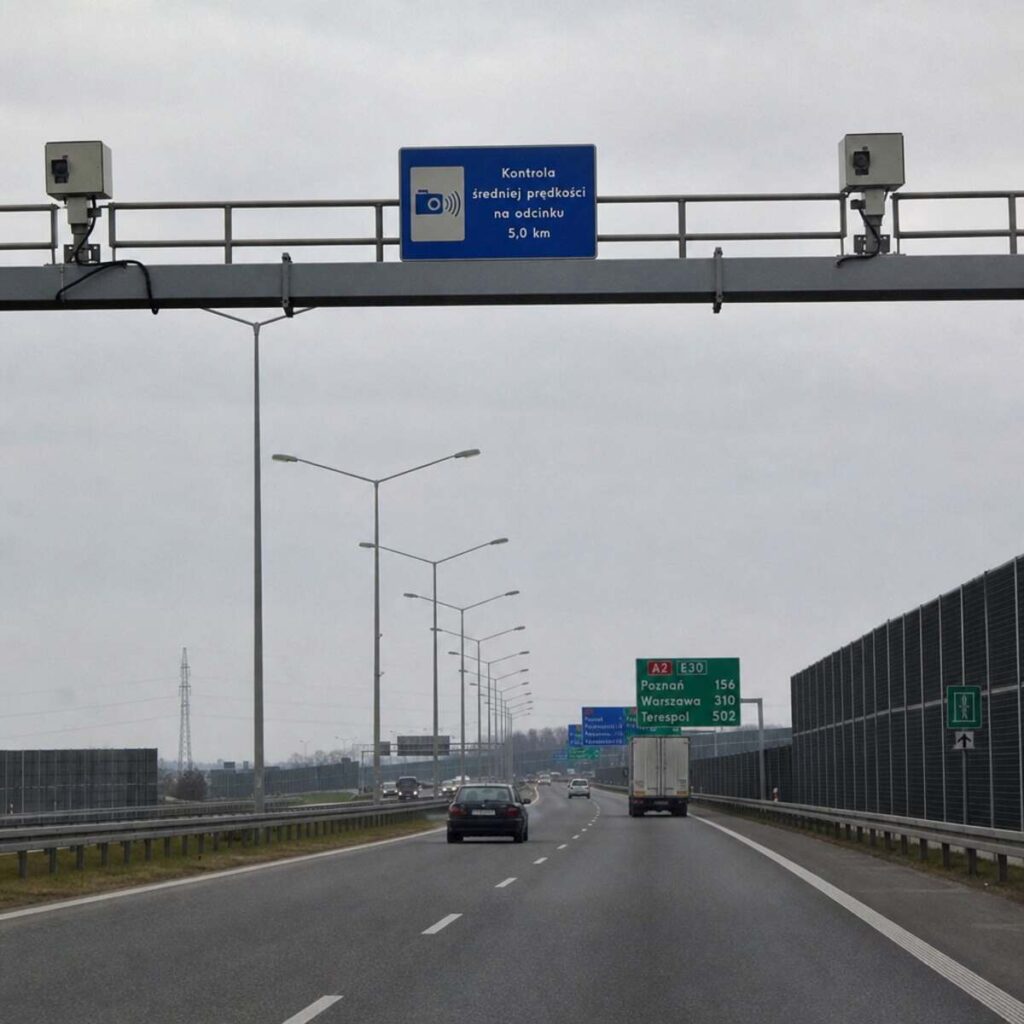
Sectional speed measurement is Poland’s way of checking whether drivers keep a legal average speed across a whole stretch of road, not just at one camera point. In Poland, the system is known as odcinkowy pomiar prędkości, often shortened to OPP, and it is run within the CANARD automatic road supervision system. This guide explains how it works, where drivers can check the Map of sectional speed measurements in Poland, and how this approach fits beside other speed measurement techniques. Learn the best info about odcinkowy pomiar prędkości.
What are sectional speed measurements in Poland?
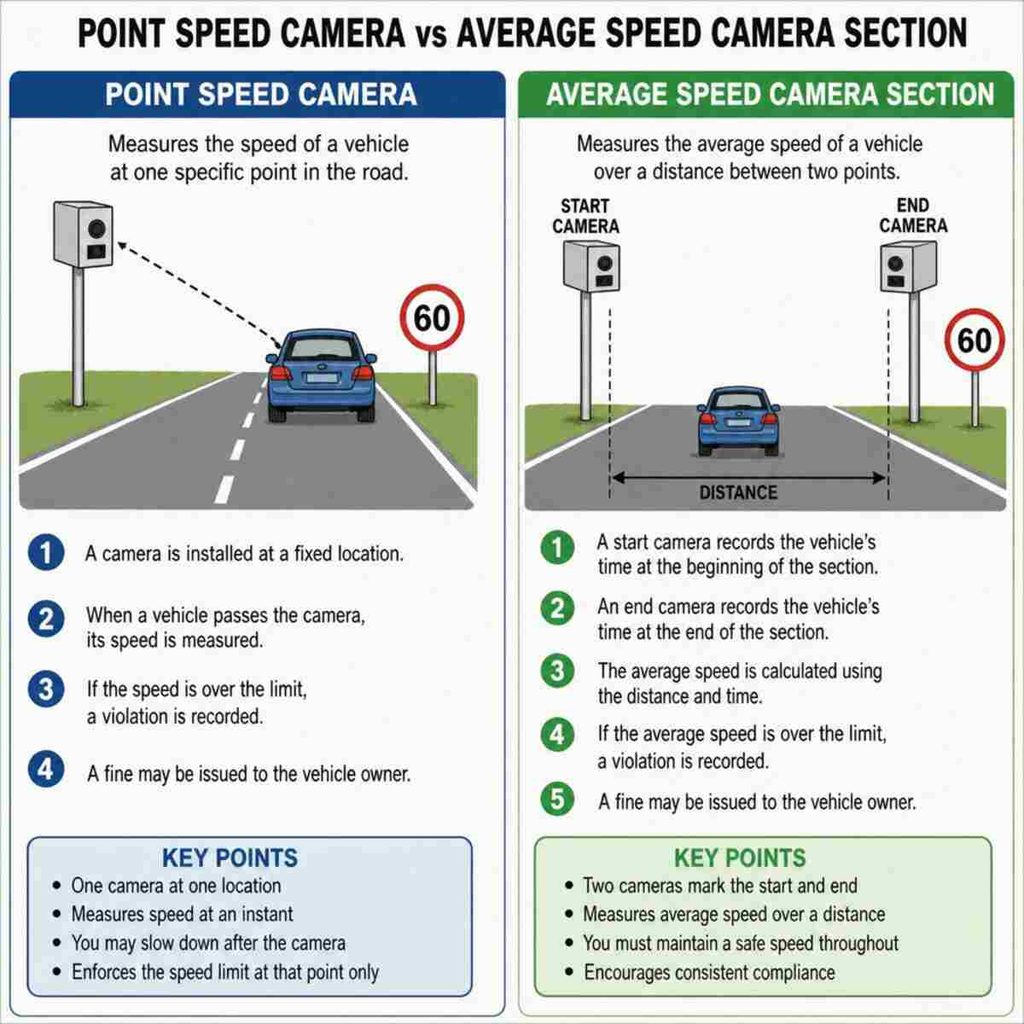
Sectional speed measurements in Poland are average-speed checks carried out between the start and end of a marked road section. A camera system records when a vehicle enters the section and when it leaves, then the system calculates the average speed for that distance. CANARD explains that these devices are used on dangerous road sections and that the system calculates average speed from the travel time between the beginning and end of the monitored route.
This is different from the classic roadside speed camera. A normal fixed camera checks a vehicle at one point. OPP checks the whole journey through a zone. That small difference changes driver behavior: instead of braking hard near a visible camera and speeding up again, drivers need to keep a steadier, legal pace across the full measured distance.
In simple terms, sectional speed measurement asks one question: how fast did you really travel through this section overall? If the distance is 5 km and the limit is 100 km/h, the system knows roughly how long a legal trip through that section should take. If the recorded time is too short, the average speed is too high.
How does Poland’s OPP system work?
Poland’s OPP system works by pairing entry and exit points. At the first point, cameras identify the vehicle and record the entry time. At the second point, cameras identify the same vehicle and record the exit time. The system then compares the calculated average speed with the legal speed limit for that monitored section. CANARD describes OPP as part of Poland’s automatic traffic supervision, alongside fixed cameras, red-light monitoring, and mobile devices.
Here is the process in a clean step-by-step way:
- A driver enters a marked OPP section. The start is shown by road signs and usually visible camera equipment.
- The system records vehicle data. This typically includes the vehicle image, plate, location, and time.
- The driver travels through the controlled section. The limit may be the same throughout that stretch, which is important for fair calculation.
- The vehicle passes the exit point. Another camera set records the exit time.
- The system calculates the average. It divides the section length by the travel time.
- A possible violation is reviewed. If the calculated average is over the permitted speed, CANARD can begin the enforcement process.
A key thing to understand is that OPP does not need to know your exact speed every second. It only needs the measured distance and the time taken to travel it. That is why “I slowed down at the camera” is not a useful strategy. If the full-section average is still too high, the system can still detect the violation.
A quick example
Imagine a controlled road section is 10 km long and the limit is 100 km/h. At that limit, the trip should take about 6 minutes. If a vehicle completes the section in 5 minutes, its average speed is about 120 km/h. Even if the driver slowed near the exit camera, the total time still shows that the car moved too quickly through the section.
This is the part many drivers miss. Sectional measurement is not really about catching one sudden burst of speed. It is about encouraging a calmer average across the whole area, especially where the road has a higher risk of crashes, tunnels, curves, junctions, or heavy traffic.
The Map of sectional speed measurements in Poland
The best starting point for checking official device locations is the CANARD device map. CANARD states that its map is illustrative rather than an official legal document, and it includes layers for point speed measurement, sectional speed measurement, red-light registration, and control points.
That warning matters. A map is useful for planning and awareness, but the road signs in front of you still matter most when you are driving. Device networks change, new sections can be added, and some locations may be in testing or not yet active. So, if you search for a “Map of sectional speed measurements in Poland,” treat it as a planning aid, not as permission to ignore signs or limits.
As of September 29, 2026, CANARD’s public information page says it has 116 sectional speed measurement devices and that they will cover about 660 km of roads. A third-party interactive OPP map, updated on September 29, 2026, listed 112 active OPP locations on 55 roads across all 16 voivodeships. Those figures are close but not identical, and that is normal: one count may include devices, another may count active road sections, and activation status can change.
For practical use, check locations in this order:
- Official CANARD map for the main public device reference.
- Road signs on the route for the legally relevant driving information.
- Navigation apps or transport maps for trip planning, with the understanding that they may lag behind changes.
- Recent local road notices when traveling through new expressway, motorway, or tunnel sections.
If you are planning a long route through Poland, it is wise to check the map before leaving, then simply drive to the posted limit. That sounds obvious, but it removes the stress of trying to remember every OPP point. The safest system is the boring one: steady speed, enough distance, and no last-second braking.
Why Poland uses average speed enforcement
Poland uses average speed enforcement because some road risks cannot be handled well by one camera at one point. A fixed speed camera can slow drivers near a school, junction, or known danger point. Sectional measurement can calm traffic along a longer stretch, which is more useful where risk builds over distance.
CANARD says the core aim of its automatic supervision system is improving road safety by detecting speeding and red-light violations. Its explanation of OPP also points to the main safety benefit: encouraging drivers to reduce speed across the entire monitored section, not only at one visible device.
This approach is especially useful in places where “point behavior” does not solve the problem. For example, a driver may slow for a camera but speed again through a tunnel. Or traffic may be dense along a several-kilometer commuter road, where repeated speeding creates constant risk. OPP changes the incentive. It rewards steady compliance instead of quick braking.
There is also a teaching effect. When drivers know a whole section is measured, they tend to pay more attention to the speed limit and the rhythm of traffic. This can reduce harsh braking, aggressive overtaking, and the stop-start behavior that happens when everyone reacts to a single camera at the last moment.
OPP compared with other speed measurement techniques
Poland uses several speed measurement techniques, and each one has a different job. The point is not that one method is always better. The point is that each technique fits a different kind of road risk.
| Technique | What it measures | Best suited for | Driver behavior it encourages |
|---|---|---|---|
| Fixed speed camera | Speed at one point | Specific danger spots, junction approaches, built-up areas | Slowing at a precise location |
| Sectional speed measurement | Average speed across a distance | Longer dangerous stretches, tunnels, expressways, motorways | Holding a steady legal speed |
| Mobile speed control | Speed during patrol or temporary checks | Flexible enforcement, complaint areas, changing risks | General caution because checks can move |
| Red-light monitoring | Entry on red signal | Signalized junctions and rail-road crossings | Stopping correctly at signals |
| Traffic counters and road studies | Traffic volume and patterns, sometimes speed trends | Planning, design, and long-term analysis | Not direct enforcement, but better road management |
GDDKiA also runs continuous traffic measurement stations on the national road network for planning and analysis. These stations collect traffic information automatically and support work such as traffic forecasting, road management, and design analysis; they are not the same thing as OPP enforcement.
So, when people discuss speed measurement techniques, it helps to separate enforcement from traffic analysis. OPP is enforcement. A roadside traffic counter may be for planning. A police laser check is another form of enforcement. They all measure movement, but they do not all lead to the same process.
How OPP is shown on Polish roads
Polish road rules require information signs for automatic speed control. The relevant regulation says the D-51 sign is used to inform drivers about automatic recording devices that check and record vehicle speed. It also states that when devices detect speed violations on a specific road section, a D-51 sign with a plate reading “Kontrola średniej prędkości na odcinku…” is placed before the start of that section.
In normal driving, you do not need to memorize the regulation. You need to recognize the pattern. Before an OPP zone, look for a sign telling you that average speed is being controlled over a given distance. You may also see yellow camera equipment mounted near gantries, poles, or structures over the road.
What drivers should look for
- A sign before the measured section. This tells you that automatic speed control is ahead.
- A plate describing average speed control. It may state the length of the controlled section.
- Visible camera equipment. In many places, cameras are mounted at the beginning and end.
- The posted speed limit. This is the number that matters for the average calculation.
- A change in road context. Tunnels, construction-like geometry, heavy traffic, or junction areas often demand extra attention.
The regulation also gives placement distances for D-51 signs before fixed recording devices: 100–200 m on roads with limits up to 60 km/h, 200–500 m on roads above 60 km/h except expressways and motorways, and 500–700 m on expressways and motorways. For average-speed sections, the important point is that the sign appears before the controlled stretch, so drivers are warned before measurement begins.
Common mistakes drivers make in OPP zones
The most common mistake is treating OPP like a normal camera. A driver sees equipment, brakes, passes it slowly, and then accelerates. That may work with a point camera if the speeding happened elsewhere, but it misses the logic of average-speed enforcement. In an OPP zone, the whole controlled section matters.
Another mistake is focusing only on the start and end. A driver might enter carefully, speed in the middle, then slow before the exit. Depending on time lost and distance covered, that may still produce an illegal average. More importantly, it defeats the safety purpose of the system.
Here are the habits to avoid:
- Braking hard at the first camera. This can surprise drivers behind you and increase collision risk.
- Speeding in the middle of the section. The average may still exceed the limit.
- Relying only on navigation warnings. Apps can be wrong, late, or outdated.
- Copying the speed of local drivers. Someone else’s confidence is not legal protection.
- Forgetting that limits can change. Always follow the posted signs, not yesterday’s memory.
- Using cruise control without checking conditions. Cruise control helps only if the set speed is legal and safe for traffic, weather, and road layout.
A better habit is simple: when you see the OPP sign, settle into a legal speed early. Leave a generous following distance. Avoid racing to the end of the section. The goal is not to “beat” the system. The goal is to drive through it so smoothly that it becomes uninteresting.
Does sectional speed measurement make roads safer?
Sectional speed measurement can support safer roads because it targets speed across a full stretch rather than one instant. CANARD’s safety argument is that OPP encourages speed reduction along the whole monitored route, which can improve safety for all road users.
Older CANARD information also reported large safety improvements at monitored sections, including declines in crashes, fatalities, and injuries, although those figures came from an earlier stage of the system and should not be treated as a universal guarantee for every location. The more careful takeaway is this: average-speed control is designed for places where consistent speed matters, and it is most useful when combined with good road design, clear signs, reasonable limits, and driver attention.
It is also fair to say that OPP has limits. It calculates an average, so it may not show every moment of dangerous behavior. A driver could theoretically speed briefly, then slow enough to bring the average down. That does not make the behavior safe; it just shows why OPP is one tool, not the whole road-safety toolbox.
The strongest safety result usually comes from layering tools. Good signage helps drivers understand what is expected. Road design makes the safe behavior feel natural. Enforcement discourages risky behavior. Education explains why the limit exists in the first place.
How to drive through an OPP section calmly
Driving through an OPP section is easy if you treat it as a pacing exercise. You do not need tricks. You need a steady speed, awareness of the posted limit, and enough patience to avoid unnecessary acceleration.
Use this short checklist:
- Read the sign early. Notice the OPP warning and the speed limit before the section begins.
- Ease into the correct speed. Do not slam the brakes unless traffic requires it.
- Keep the speed stable. Cruise control or a speed limiter can help on open roads, but only when conditions are suitable.
- Watch for lower limits. Roadworks, weather signs, urban zones, or tunnel rules may change what is safe or legal.
- Leave space. Tailgating in an average-speed zone adds stress and risk.
- Ignore pressure from impatient drivers. If someone wants to go faster, do not let that push you above the limit.
- Stay alert after the section ends. The end of OPP is not a signal to accelerate aggressively.
A calm driver is usually a smoother driver. Smooth driving saves attention, reduces sudden braking, and makes long trips less tiring. That is especially useful in Poland, where motorways and expressways can shift quickly from open-flow traffic to congestion near cities, junctions, and roadworks.
Planning a route with OPP in mind
If you are using a map before a trip, do not treat OPP locations as obstacles. Treat them as reminders of where the road authority sees a safety concern. That small mental shift makes route planning easier. You are not planning how to avoid enforcement; you are planning how to drive comfortably through areas where steady speed matters.
A sensible pre-trip routine looks like this:
- Check your route. Look at major roads, tunnels, bypasses, and city approaches.
- Check the CANARD device map. Use it for a broad view of fixed and sectional controls. Remember that CANARD describes the map as illustrative.
- Compare with your navigation app. It may show warnings, but do not rely on it as your only source.
- Note long measured sections. Longer zones require more patience because one burst of speed can affect the average.
- Plan breaks. Fatigue leads to sloppy speed control, late braking, and poor judgment.
- Drive by signs. Once on the road, signs and conditions take priority over pre-trip notes.
This is especially helpful for visitors who are unfamiliar with Polish terms. If you see odcinkowy pomiar prędkości, think average speed control over a section. If you see kontrola średniej prędkości, think your average speed is being checked. You do not need perfect Polish to understand the driving instruction: hold a legal, steady speed until the controlled section is over.
Why map numbers can differ
If you compare several sources, you may notice different counts for sectional speed measurements Poland. One website may count active locations. Another may count devices. Another may include planned, installed, tested, or newly activated sections. This is why numbers can look inconsistent even when the sources are not necessarily wrong.
For example, CANARD’s page gives a device count and total controlled road length, while a third-party interactive map gives active OPP points by road and voivodeship. Those are related measures, but they are not identical. A single controlled location may use multiple devices, and a newly installed system may not be active at the same moment a private map updates.
When reading any OPP map, ask these questions:
- Is it official, commercial, or community-based? Official sources carry more authority, while third-party maps may be easier to browse.
- What date is shown? A map without an update date is less useful.
- Does it show active systems only? Some maps include planned or recently installed sections.
- Is it counting devices or road sections? Those numbers can differ.
- Does it separate OPP from fixed cameras? Mixing all enforcement types can confuse drivers.
A good map helps you prepare. It should not become a substitute for safe driving. If a map says no OPP is nearby but the road sign says average speed is controlled, trust the sign.
What this means for everyday drivers
For everyday drivers, OPP is less complicated than it first sounds. It simply extends the meaning of “follow the speed limit” from one point to a full section of road. You do not need special equipment, special knowledge, or nervous calculations in your head.
The practical lesson is to drive in a way that makes the average obvious. If the limit is 90 km/h, do not hover at 105 and hope traffic lights, congestion, or braking will fix the average later. If the limit drops, adjust early. If traffic is heavy, leave room instead of trying to maintain a perfect number.
For professional drivers, delivery drivers, and frequent motorway users, OPP also changes time planning. You cannot reliably make up time by speeding through a controlled section. It is better to build a realistic schedule, allow for roadworks and rest stops, and avoid the constant speed-up-slow-down cycle that drains focus.
For families and tourists, the main benefit is predictability. Once you understand the system, it becomes one less thing to worry about. See the sign, set the pace, keep distance, and continue.
The main takeaway
Poland’s sectional speed measurement system is built around a simple idea: road safety improves when drivers keep a legal speed across the whole risky stretch, not only near a single camera. OPP records entry and exit times, calculates average speed, and fits into a wider set of speed measurement techniques used for enforcement, planning, and traffic safety.
If you want to check the Map of sectional speed measurements in Poland, start with CANARD’s device map and use other interactive maps only as helpful planning tools. The numbers may differ because sources count devices, active sections, and planned locations in different ways. Once you are on the road, the best advice is still the simplest: read the signs, drive smoothly, and keep your average speed comfortably within the limit.