


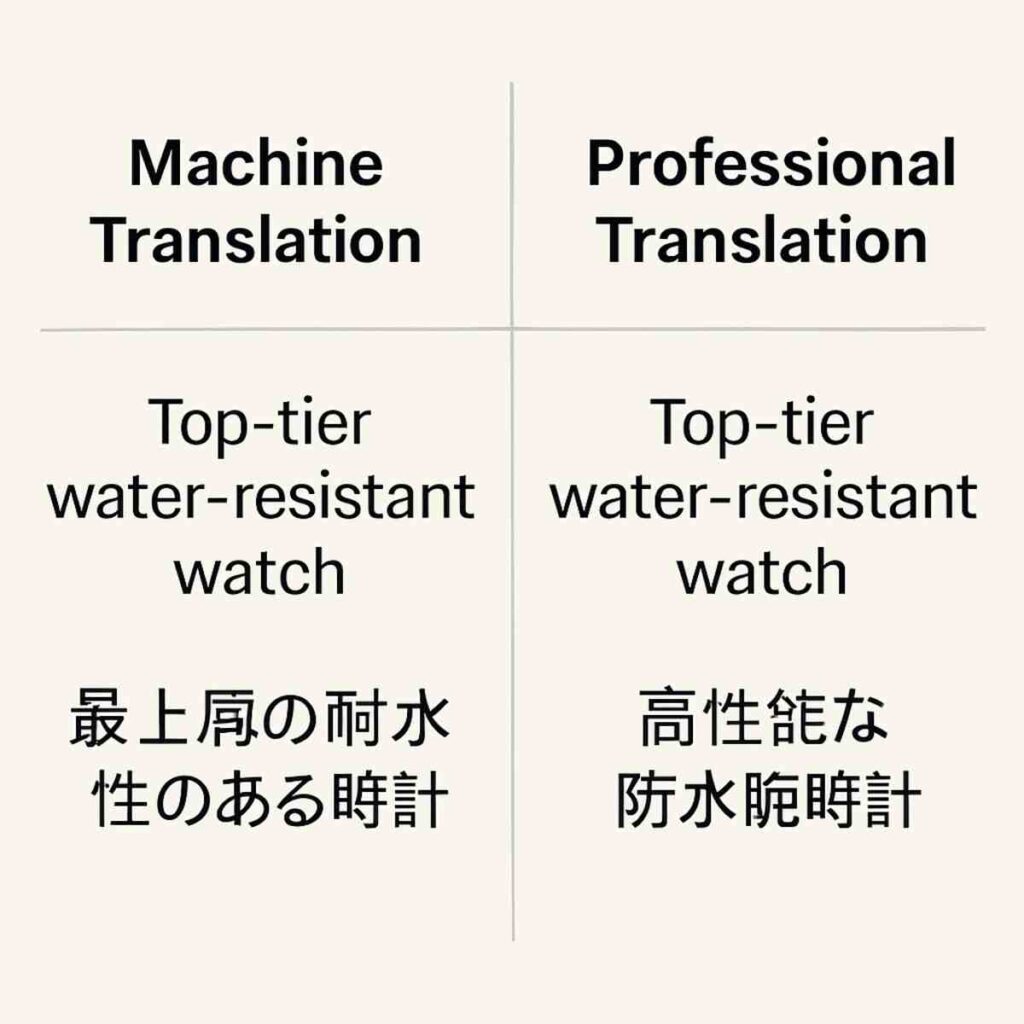
We’ve all done it. You copy a block of foreign text, paste it into a free online translator, and get an instant, “good enough” answer. For figuring out a menu or a short social media post, these tools are a modern marvel. They give us a quick glimpse into another language, and most of the time, that’s all we need.
But what happens when “good enough” can cause a disaster for your business? This is where free tools create costly business translation mistakes. Marketers often point to the classic story of the Chevy Nova, which struggled in some Spanish-speaking countries because its name sounded like “no va”—meaning “it doesn’t go.” Whether an urban legend or not, the lesson is powerful: a simple oversight in language can accidentally redefine your entire product.
These problems arise because professional translation isn’t just about swapping words; it’s about conveying meaning, tone, and cultural intent. A machine can change the words in a legal contract or a safety manual, but it can’t understand the liability or human risk behind them. This is why using professional translation services is essential for any content that protects your customers, your finances, or your brand’s reputation.
Navigating this world to find the right partner might seem daunting, but it doesn’t have to be. This guide provides a clear framework for ensuring your message connects perfectly, in any language.
Human vs. Machine: Why Your Business Needs More Than Word-Swapping
Free online tools are fantastic for getting the gist of a foreign email or website. In seconds, you can swap words from one language to another. But when your brand’s reputation is on the line, is that enough? The short answer is no, because translation is about conveying meaning, not just trading words.
The key difference in the human translator vs machine translation debate lies in understanding context and intent. A machine sees a phrase like “it’s raining cats and dogs” and might translate it into confusing nonsense about animals falling from the sky. A professional human translator understands the idiom and finds the equivalent local phrase for a heavy downpour, ensuring your message is clear and natural by translation companies.
This isn’t just about avoiding funny mistakes. Your tone of voice—whether it’s professional, witty, or reassuring—is a huge part of your brand. An overly literal, machine-generated translation can strip away that personality, making your marketing sound robotic or your instructions unclear. An accurate translation by a professional preserves that vital context, making sure you sound like you in any language.
Ultimately, relying on word-swapping tools for customer-facing content is a gamble with their trust. One of the main benefits of using a language service provider is having a human expert who protects your brand’s credibility. They don’t just change the language; they ensure the meaning, tone, and cultural appropriateness are perfect.
Going Beyond Words: What Are Localization and Transcreation?
Sometimes, just changing the words isn’t enough to truly connect with a new audience. This is where a service called localization comes into play. If translation changes the language of your content, localization changes the entire experience to feel completely native. It’s the key to successfully adapting a website for international audiences or making a software app feel like it was built just for them.
The difference between translation and localization becomes clear when you see what gets adapted. It goes far beyond just text to include cultural and regional conventions that build trust:
- Dates and times: Changing the US format (12/25/2024) to the European one (25.12.2024).
- Currency and measurements: Displaying prices in euros (€) instead of dollars ($).
- Images and colors: Swapping out photos to reflect local people and ensuring colors don’t have a negative cultural meaning.
For highly creative content like advertising slogans or brand taglines, you need an even more specialized approach: transcreation. This isn’t translation; it’s creative recreation. The goal of transcreation for marketing materials is to scrap the original words and rebuild the message from the ground up to create the same emotional impact and persuasive punch in a new culture with translation companies uk.
While these services help your brand fit into a new market, some documents can’t be creatively adapted. When you’re dealing with official papers like contracts or birth certificates, the rules change entirely, and absolute, verifiable accuracy becomes a legal necessity.
When ‘Good Enough’ is a Legal Disaster: A Guide to Certified and Notarized Translation
For official documents like birth certificates, university transcripts, or legal contracts, there is no room for creative interpretation or “good enough” machine translations. Submitting an inaccurate or unofficial translation can lead to costly delays or outright rejections by governments and institutions. This is where the world of legally recognized translation comes into play, ensuring every word is accounted for with verifiable precision.
The most common requirement is a certified translation. This isn’t a special license a translator holds, but rather a formal guarantee they provide. After completing an accurate legal document translation, the translator or agency attaches a signed statement, or “certificate of accuracy,” attesting that the translation is a complete and true representation of the original document. This process is crucial for most official uses, including certified document translation for immigration (USCIS).
Sometimes, an institution will ask for an extra layer of validation: a notarized translation. It’s a common point of confusion, but the notary’s role is very specific. They do not check the quality of the translation. Instead, they verify the identity of the person signing the certificate of accuracy. A notarized translation simply confirms that the translator who certified the document is who they claim to be, adding a formal seal of authenticity to the signature itself.
So, how do you know what you need? The answer always comes from the institution requesting the document. Before you start the process, ask them directly: “Do you require a certified translation, and does it also need to be notarized?” Knowing precisely what to ask for is the first step in how to get a document officially translated correctly, saving you time, money, and stress.
Building Your Translation Team: Agency vs. Freelancer?
Once you know what kind of translation you need, the next question is who to hire. This decision usually comes down to a classic translation agency vs freelancer choice. Both can deliver excellent work, but they shine in different scenarios. Understanding their core strengths is the key to picking the right partner for your project.
Think of a translation agency as a general contractor for your language needs. If you have a large website to translate into five languages, an agency is your one-stop shop. They handle all the moving parts: finding the right translators, managing deadlines, and performing quality checks. The primary benefits of using a language service provider are this built-in project management and the capacity to handle large, complex, multilingual jobs seamlessly.
A freelance translator, on the other hand, is a specialist. You hire them for their deep expertise in a specific area, like a legal contract or a technical manual for a product you designed. Working directly with a freelancer means you have a single point of contact and can build a close working relationship, which is ideal for ongoing projects that require a consistent voice and deep subject matter knowledge.
Deciding on how to choose a translation agency or a freelancer depends entirely on your needs.
- Choose an Agency if… you have large volumes of content, need translation into multiple languages, or want a hands-off experience where project management is included.
- Choose a Freelancer if… you have a single, specialized document, value direct communication, or are working with a tight budget for a smaller task.
Regardless of which path you take, knowing what quality looks like is essential.
Two Telltale Signs of a High-Quality Translation Provider
When you’re vetting potential partners, it’s easy to get distracted by a sleek website or a low price. But true quality lies in two areas that are less obvious: the people and the process. The first thing to look for is a subject matter expert translator. You wouldn’t ask a family doctor to perform brain surgery, and the same logic applies here. For a legal contract or a technical manual, you need more than a bilingual person; you need a linguist who is also an expert in law or engineering. They understand the specific terminology and context, which is the foundation of an accurate translation.
Beyond individual expertise, look for proof of a reliable process. This is where a credential like ISO 17100 certified translation comes in. Think of it as an international seal of approval, not for the translator, but for the agency’s entire quality system. This certification guarantees the provider follows strict, documented steps for everything—from vetting their translators to performing a separate review and proofread after the initial translation. It’s a verifiable promise of professionalism that goes far beyond marketing claims.
By focusing on these two factors—the expertise of the people and a certified process—you can confidently determine how to choose a translation agency or freelancer that will protect your brand and deliver your message correctly.
The Price Tag on Precision: How Professional Translation Costs Are Calculated
Unlike a physical product with a fixed price, the professional translation services cost is typically based on the work involved, most commonly calculated on a per-word basis. For business content like a website, brochure, or user manual, this model is the industry standard because it’s transparent and fair—you only pay for what needs to be translated. Rates can vary, but this approach ensures the price directly reflects the volume of your text.
For certain official documents, however, a different model makes more sense. The cost of certified translation per page is standard for items like birth certificates, academic transcripts, or legal papers. Because these documents often have a low word count but require precise formatting and a formal certification statement to be legally valid, pricing by the page better captures the value and liability the translator assumes. This fee usually includes the translation, formatting, and the signed certificate of accuracy.
Beyond the pricing model, three key factors will influence your final quote. The first is the language pair; translating from English to a common language like Spanish is generally less expensive than translating to a rarer one. The second factor is complexity—a simple marketing email will cost less per word than a highly technical engineering patent that requires a specialized expert. Finally, urgency plays a big role, as rush projects that require translators to work overnight or on weekends will naturally command a higher rate.
To give you a ballpark idea, you might see per-word rates ranging from $0.15 to $0.30 for standard business content, while per-page certified translations often start around $40-$50. Understanding this translation pricing is the first step to planning your project.
From Your File to a Final Draft: What to Expect in a Translation Project
Once you’ve received a quote and are ready to move forward, the translation project management process is surprisingly straightforward. When working with a translation agency, you’ll be assigned a dedicated project manager. This person is your single point of contact, responsible for understanding your needs—not just the target language, but also the intended audience and tone. They ensure the right expert is assigned to your project, whether it’s for a technical manual or a creative marketing slogan.
This is where the real work begins. To guarantee quality, professional services use a three-step quality check. First, a native-speaking translator crafts the initial translation. Then, a second independent linguist edits that work, refining the text for flow, accuracy, and cultural nuance. Think of it like having an editor review an author’s manuscript. Finally, a proofreader performs one last check to catch any typos or formatting errors, ensuring the final document is flawless.
Finally, you’ll receive your completed translation, formatted and ready to use. If you need to know how to get a document officially translated, this is also when you would receive the signed certificate of accuracy for things like legal papers or academic records. Your project manager delivers the files and confirms everything meets your expectations. This reliable, multi-step process is the standard for quality and the key to a successful partnership.
Your 5-Point Checklist for Choosing the Right Translation Service
You now understand the difference between a quick fix for casual understanding and a quality investment for when your message, brand, or legal standing demands a professional. To put this knowledge into practice, use this straightforward checklist the next time you need to cross a language barrier.
- What are the stakes? (Casual info vs. a legal or brand risk?)
- Who is the audience? (Does the message need cultural adaptation?)
- What is the content? (Simple text vs. specialized legal or medical terms?)
- What is the scale? (One page vs. a huge project in five languages?)
- Does it need a stamp? (Is a certified or notarized document required?)
With these questions, you are in control. You can confidently assess your needs and understand exactly what you’re paying for. The next time a project lands on your desk, you’ll know how to choose a translation agency that protects your work and connects you with the world.